
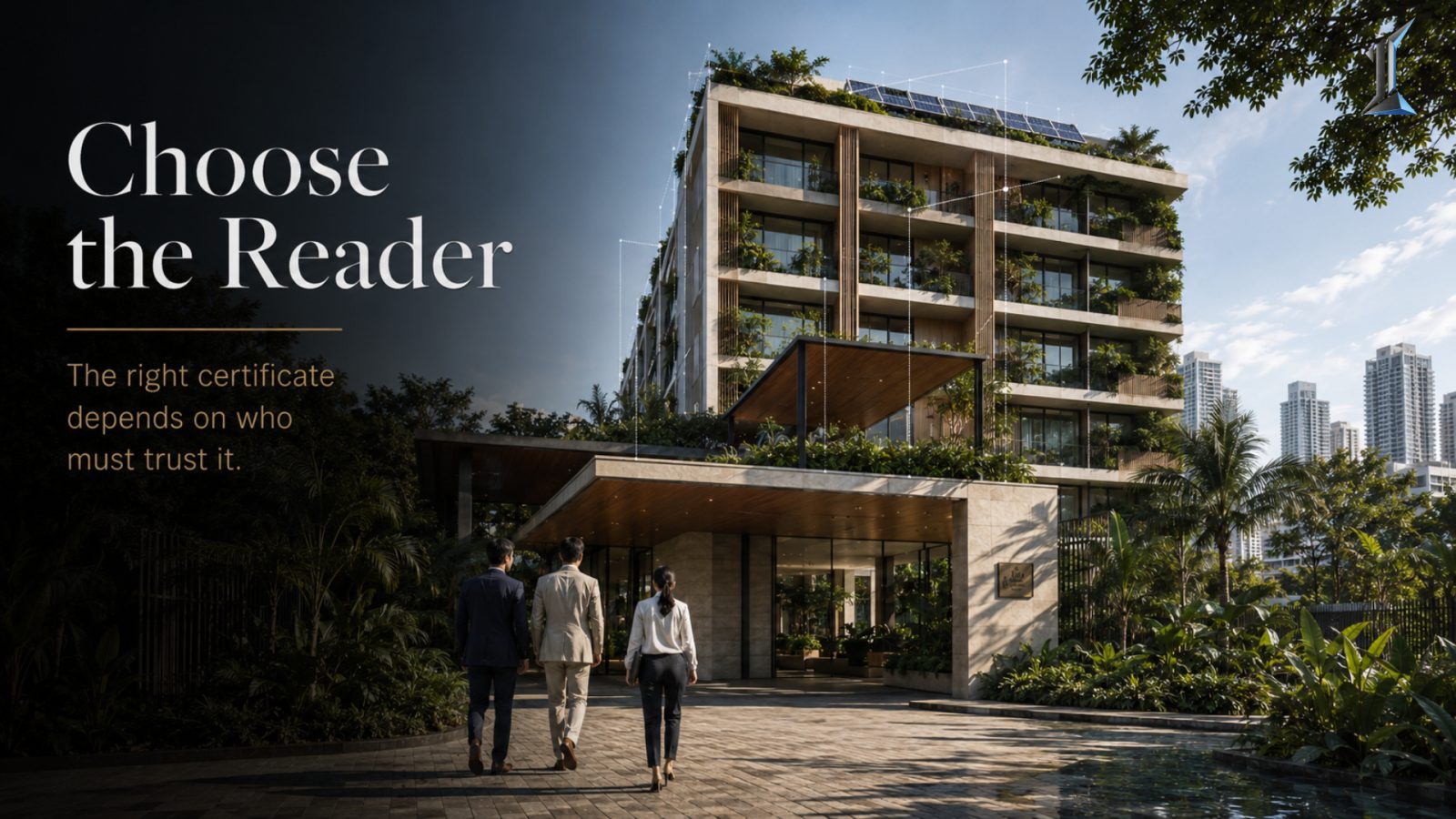
BREEAM vs LEED vs EDGE: Choosing the Right One
BREEAM, LEED, and EDGE are often treated as three versions of the same certificate. They are not. Each was built by a different institution for a different market and a different reader. This piece lays out a selection framework for mid-rise residential in Phnom Penh, working backward from who owns
There are three initials a developer in this region will hear when the subject of green certification comes up: BREEAM, LEED, and EDGE. They are often discussed as if they were three brands of the same product. They are not. Each was built by a different institution, for a different market, to answer a different question, and the choice between them is less about which is best and more about who will be reading the certificate.
BREEAM is the oldest of the three. The Building Research Establishment created it in the United Kingdom in 1990, which makes it the first system of its kind. LEED followed from the United States and became the internationally recognized name. EDGE is the youngest and the most specific, built by the International Finance Corporation, a member of the World Bank Group, for emerging markets. Cambodia is squarely one of them.
Three systems, three centers of gravity
BREEAM scores a building across weighted categories and translates the result into a rating: Pass at 30 percent, Good at 45, Very Good at 55, Excellent at 70, and Outstanding at 85 and above. Fewer than one percent of certified buildings reach Outstanding. The system rewards verified operational data, and its current version pushes whole-life carbon accounting to the front of the design process. Its center of gravity is European institutional capital.
LEED works on points and tiers. The current version, LEED v5, sets Certified at 40 to 49 points, Silver at 50 to 59, Gold at 60 to 79, and Platinum at 80 and above. It carries the strongest international name recognition of the three, which is its real currency. A Gold plaque communicates the same thing in Frankfurt as it does in Singapore.
EDGE asks one quantitative question. Does the building project at least a 20 percent reduction in energy use, water use, and embodied energy in materials, measured against a standard local building. Clear that bar across all three and the project is EDGE Certified. Reach 40 percent energy savings and it becomes EDGE Advanced, which the IFC labels Zero Carbon Ready. The system is fast, the modeling software is free, and certification is a one-time award.
What each one is actually asking of the design
The differences in scoring are not academic. They change what the design team has to prove.
BREEAM, at its higher ratings, demands measured evidence rather than design intent. The gap between Very Good and Excellent is rarely a matter of trying harder. It is a matter of whether you can produce twelve months of verified energy data, which means the building has to be instrumented and operated before the rating fully lands.
LEED rewards ambition across a broad set of weighted impact categories, from energy to water to materials to indoor environment. It is the most comprehensive of the three and the most documentation-heavy. EDGE, by contrast, is deliberately narrow. It measures three resource streams against a local baseline and stops there. That narrowness is the point. It was engineered to move a market from a handful of showcase green buildings to a large number of merely efficient ones.
The Phnom Penh reading
For a mid-rise residential project in this city, the selection logic tends to resolve quickly, and it resolves around the future owner and the source of capital.
EDGE was built for exactly this situation. Its baseline adjusts to local climate and construction norms, its 20 percent threshold is reachable with standard technology rather than imported systems, and it is directly linked to green financing from development finance institutions and the banks that work with them. For a developer whose capital stack touches IFC-aligned lenders, the certificate is not a marketing badge. It is a financing instrument.
LEED enters when the exit involves international owners or institutional buyers who read the plaque before they read the drawings. The recognition premium is real, and for a project positioned toward foreign capital it can be worth the heavier documentation load. BREEAM is the rarest of the three here, because its natural audience sits in the United Kingdom and Europe. Pursuing it in Phnom Penh usually signals a specific European investor relationship rather than a general market strategy.
The framework underneath the acronyms
The honest way to choose is to work backward from three questions. Who owns this building in year fifteen. Where does the capital that finances it come from. Who is the certificate meant to convince.
Answer those and the standard usually selects itself. A locally financed residential project aimed at domestic and regional owners points to EDGE. A project built for an international institutional exit points to LEED. A project tied to a European capital relationship points to BREEAM. The mistake is to pursue a certificate because it sounds impressive, then discover that the reader it was meant for never sees it.
None of this changes the underlying discipline. A building oriented properly, shaded properly, and specified for this climate will clear any of these thresholds without heroics, because the certification verifies the design rather than replacing it. A building that was not designed for the climate will struggle against all three, and no plaque will hide that at year ten.
The three standards are not competitors for the same slot. They are three different readers, each fluent in a different language of trust. The design decision that matters is made long before the certificate is chosen, in the orientation, the envelope, and the systems.
Owners who select the standard by its audience rather than its reputation tend to spend less on documentation and get more from the result. The work of deciding which certificate to pursue looks administrative, and it usually pays more than it appears to.
At Imajineer, this is the conversation we have before the first elevation is drawn, because the certificate a building will eventually carry shapes decisions made at the brief stage. The analysis is available when it is useful.